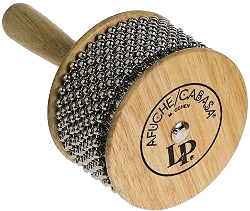
Cabasa - See Afuche, also known as a Cabasa.
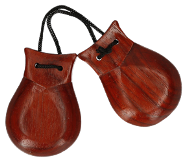
Castanets - Castanets are ancient, hand-held percussion instruments idiophones consisting of two concave wooden shells joined by a cord, producing a sharp, clicking sound. Originating over 3,000 years ago, they are integral to Spanish flamenco, folk music and orchestral, often played in pairs with different pitches to create rhythmic, articulated patterns.
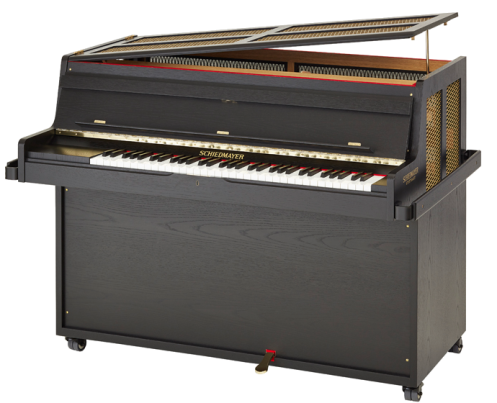
Celesta - The Celesta looks similar to an Upright Piano (4 or 5 octaves) but with smaller keys and a much smaller cabinet. The keys connect to hammers that strike a graduated set of metal (usually steel) plates or bars suspended over wooden resonators. 4 or 5 Octave models usually have a damper pedal that sustains or damps the sound. The 3 octave instruments do not have a pedal because of their small "table-top" design. One of the best-known works that uses the celesta is Pyotr Ilyich Tchaikovsky's "Dance of the Sugar Plum Fairy" from The Nutcracker.
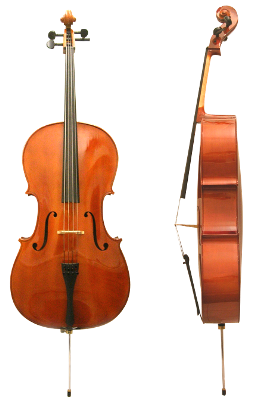
Cello - The Violoncello, commonly abbreviated as Cello, is a medium-low pitched bowed string instrument of the Violin family. Its four strings are usually tuned in perfect fifths from low to high:
C2, G2, D3 and A3. Music for the Cello is generally written in the Bass Clef; the Tenor and Treble clefs are used for higher-range passages. The Viola's four strings are each an octave higher.

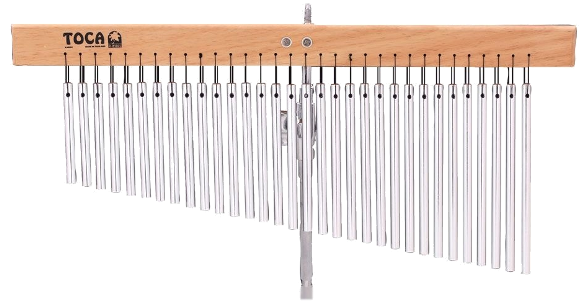
 Chimes - Chimes are a percussion instrument used primarily for musical color. It consists of many small chimes, typically cylinders of solid aluminum or brass tubing about 3/8" in diameter—of varying lengths, hung from a bar. They are played by sweeping a finger or stick through the length of the hanging chimes. They are typically mounted in pitch order to produce rising or falling glissandos.
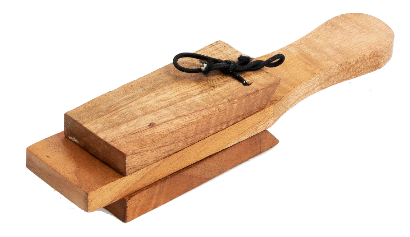
Clapper - A percussion instrument formed by 2 or more elements that are joined together and are struck together to make a percussive sound.
Clarinet - The Clarinet is a single-reed musical instrument in the woodwind family. Clarinets comprise a family of instruments of differing sizes and pitches. The clarinet family is the largest woodwind family, ranging from the Bb Contrabass to the Ab Piccolo. The Bb Soprano Clarinet is the most common type and is the instrument usually indicated by the word "Clarinet".


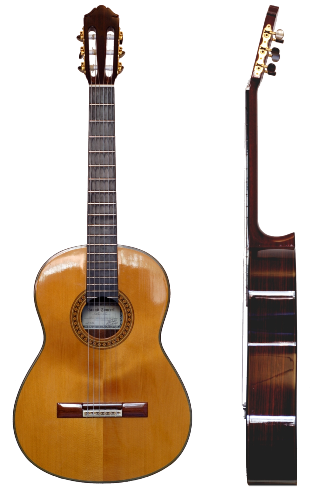
Classical guitar - The Classical Guitar, also known as a Spanish guitar, is a member of the guitar family used in Classical music and other styles. As an acoustic wooden string instrument with strings made of gut or Nylon, it is a precursor of the modern steel-string Acoustic and Electric guitars that use metal strings. Classical guitars derive from instruments such as the Lute, the Vihuela, which evolved into the Renaissance guitar and into the 17th and 18th-century Baroque guitar. Today's modern Classical guitar was established by the late designs of a 19th-century Spanish luthier, Antonio Torres Jurado.

Clavichord - The Clavichord is a stringed rectangular keyboard instrument that was used largely in the Late Middle Ages, through the Renaissance, Baroque and Classical eras. Historically, it was mostly used as a practice instrument and as an aid to composition, not being loud enough for larger performances. The clavichord produces sound by striking Brass or Iron Strings with small Metal Blades called Tangents. Vibrations are transmitted through the bridge(s) to the soundboard.


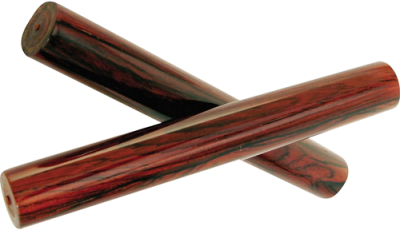
Claves - A percussion instrument consisting of 2 round, polished sticks that are struck one against the other. Cuba.
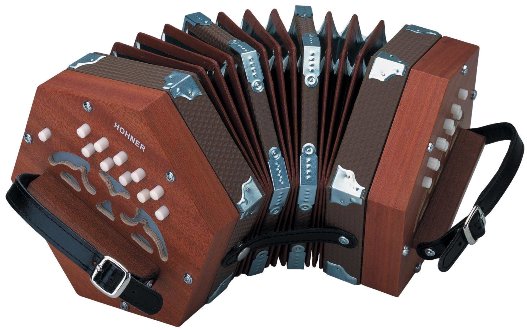
Concertina - A Concertina is a free-reed musical instrument, like the various Accordions and the Harmonica. It consists of expanding and contracting bellows, with buttons (or keys) usually on both ends, unlike Accordion buttons, which are on the front.
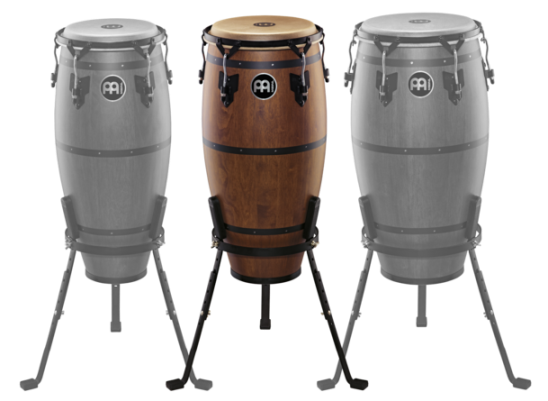
Conga - The Conga, also known as Tumbadora, is a tall, narrow, single-headed drum from Cuba. Congas are staved like barrels and classified into three types: Quinto (lead drum, highest), Tres Dos or Tres Golpes (middle) and Tumba or Salidor (lowest). Congas were originally used in Afro-Cuban music genres such as Conga (hence their name) and rumba, in which each drummer would play a single drum. Following numerous innovations in conga drumming and construction during the mid-20th century, as well as its internationalization, it became increasingly common for drummers to play 2 or 3 Conga Drums.
Conical - A Brass instrument features tubing that gradually widens in diameter from the mouthpiece to the bell, creating a warm, mellow and rich tone.
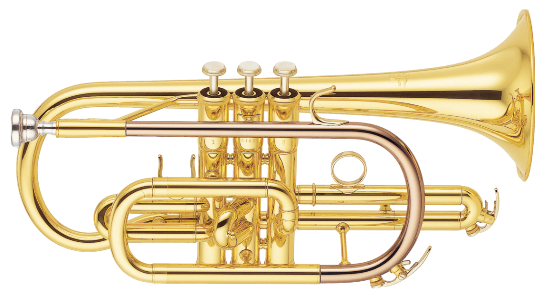
Cornet - The Cornet is a brass instrument similar to the Trumpet but distinguished from it by its conical bore, more compact shape, and mellower tone quality. The most common Cornet is a transposing instrument in Bb. There is also a soprano cornet in Eb and Cornets in A and C. All are unrelated to the Renaissance and early Baroque cornett.

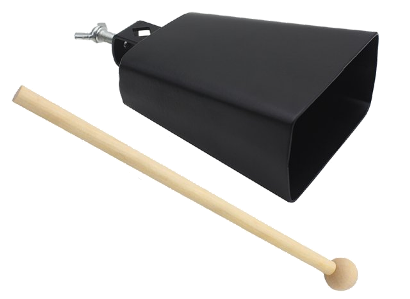
Cowbell - The cowbell is an idiophone hand percussion instrument used in various styles of music, such as Latin and rock. It is named after the similar bell used by herdsmen to keep track of the whereabouts of cows. The instrument initially and traditionally has been metallic; however, contemporarily, some variants are made of synthetic materials.
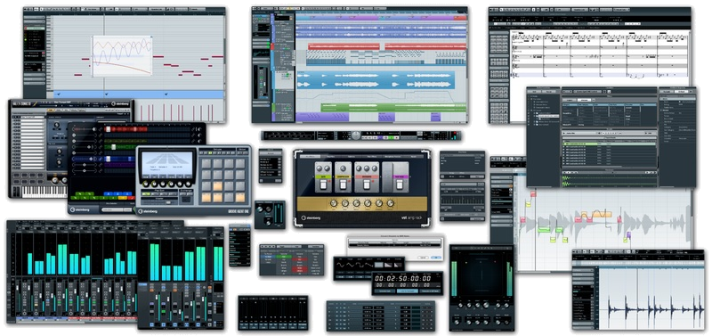
CuBase - Cubase is a Digital Audio Workstation (DAW)
software developed by Steinberg for Music and MIDI Recording, Arranging and Editing.
Cymbal - Cymbals are common percussion instruments. Often used in pairs, cymbals consist of thin, normally round plates of various copper alloys. The majority of cymbals are of indefinite pitch, although small disc-shaped cymbals based on ancient designs (such as crotales) sound a definite note. Cymbals are used in many ensembles ranging from the Orchestra and Percussion ensembles to Jazz bands, Rock bands, and Marching bands. Drum kits usually incorporate at least 1 Crash, 1 Ride, or a Crash/Ride cymbal and a pair of Hi-Hat cymbals.

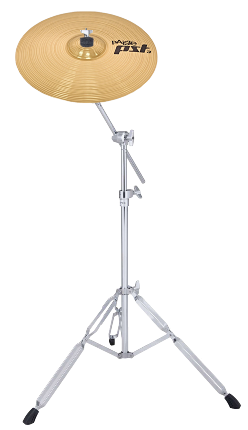
Cymbal crash - A Crash cymbal is a type of cymbal that produces a loud, sharp "crash" and is used mainly for occasional accents, as opposed to a ride cymbal. It can be mounted on a stand and played with a drum stick, or by hand in pairs. One or two crash cymbals are a standard part of a drum kit. Suspended crash cymbals are also used in bands and orchestras, either played with a drumstick or rolled with a pair of mallets to produce a slower, swelling crash. Sometimes a drummer may hit two different crash cymbals in a kit at the same time to produce a very loud accent, usually in rock music.
Although crash cymbals range in thickness from paper-thin to very heavy, all crash cymbals have a fairly thin edge. They are typically 14 to 18 inches (36 to 46 cm) in diameter, but sizes down to 8 inches (20 cm) and up to 24 inches (61 cm) are manufactured. Custom crash cymbals up to 28 inches (71 cm) in diameter have been used by big bands. Different thicknesses are used for different kinds of music, and the alloy for each manufacturer's models varies. A thick cymbal is likely to be used by a metal or rock band, while thinner cymbals are generally used in lighter rock.
Cymbal hi hat - A Hi-hat is a combination of 2 cymbals and a pedal, all mounted on a metal stand. It is a part of the standard drum kit used by drummers in many styles of music including Rock, Pop, Jazz, Country and Blues. Hi-hats consist of a matching pair of small to medium-sized cymbals (often 14 inches) mounted on a Hi-hat stand, with the two cymbals facing each other. The bottom cymbal is fixed and the top is mounted on a rod, which moves the top cymbal toward the bottom one. When the pedal is depressed (a Hi-hat that is in this position is said to be "closed" or "closed hi-hats").
The cymbals may be played by closing them together with the pedal, which creates a "chck" sound or striking them with a stick, which may be done with them open, closed, open and then closed after striking to dampen the ring, or closed and then opened to create a shimmering effect at the end of the note.

Cymbal ride - The Ride cymbal is a cymbal of material sustain used to maintain a beat in music. A standard in most drum kits, the Ride's function is to maintain a steady pattern, sometimes called a ride pattern, rather than provide the accent of a crash cymbal. It is normally placed on the extreme right (or dominant hand) of a drum set, above the floor tom. It is often described as delivering a "shimmering" sound when struck soundly with a drumstick and a clear ping when struck atop its bell.
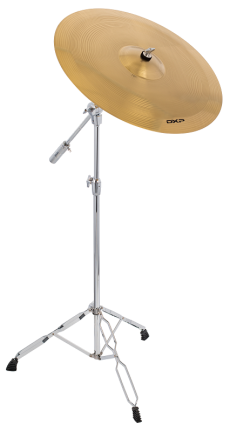
Cymbal china - a China cymbal (or Chinese cymbal) is a distinct type of cymbal designed to produce a bright, crisp, and explosive tone that has brought it the nickname trash cymbal. The name "China cymbal" comes from its shape, which is similar to that of the Chinese Bo. Such cymbals are most frequently mounted upside down on cymbal stands, allowing for them to be more easily struck and for a better sound. China-type cymbals are common in various kinds of rock music, particularly heavy metal and thrash metal. They are also frequently used in jazz fusion, Latin music, and Brazilian music, especially in arrangements with elaborate drum solos.

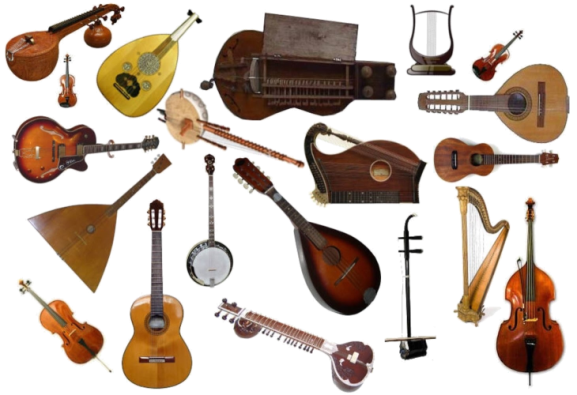
Chordophone - Chordophones are musical instruments that produce sound from Vibrating Strings when a performer strums, plucks, strikes or sounds the strings in varying manners. Musicians play some string instruments, like Guitars, by plucking the strings with their fingers or a plectrum (pick), and others by hitting the strings with a light wooden hammer or by rubbing the strings with a bow, like Violins.
|