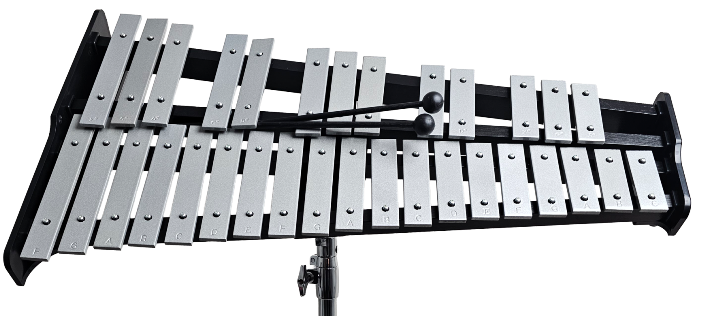
Glockenspiel - A percussion instrument that consists of metal bars of various lengths, arranged in two rows and played with small mallets.

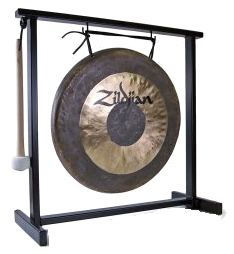
Gong - A Gong is a percussion instrument originating from Southeast Asia, and used widely in Southeast Asian and East Asian musical traditions. Gongs are made of metal and are circular and flat or bowl-like in shape and come in various sizes. They are typically struck with a mallet. They can be played alone, giving a characteristic "crashing" sound, or played as part of a tuned set that produce bell-like sounds.
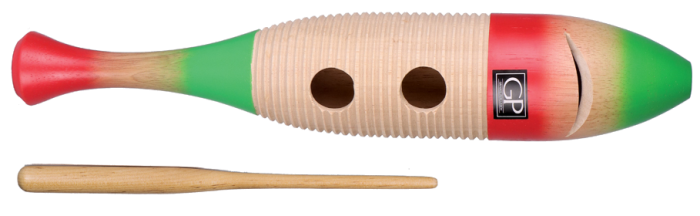
Güiro - The Güiro is a percussion instrument consisting of an open-ended, hollow Gourd with parallel notches cut in one side. It is played by rubbing a stick along the notches to produce a zipper-like ratchet sound. The güiro is commonly used in Cuban, Puerto Rican, and other forms of Latin American music, and plays a key role in the typical rhythm section of important genres like son, trova and salsa. Playing the güiro usually requires both long and short sounds, made by scraping up and down in long or short strokes. Also called a Gourd, which is the dired fruit that makes up the body of the The Güiro.
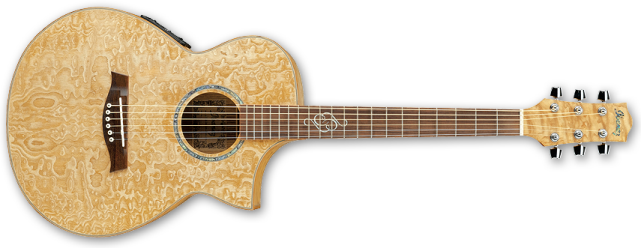
Guitar acoustic - An Acoustic Guitar is a musical instrument in the string family. When a string is plucked, its vibration is transmitted from the bridge, resonating throughout the top of the Guitar. It is also transmitted to the side and back of the instrument, resonating through the air in the body, and producing sound from the sound hole. An Acoustic Guitar produces sound without the use of electronic amplification.
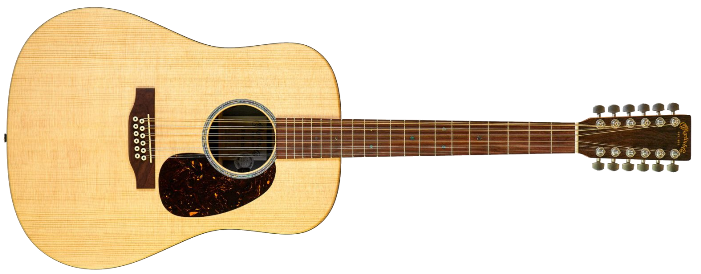
Guitar 12 string - A 12-string guitar is a steel-string guitar with 12 strings in 6 courses, which produces a thicker, more ringing tone than a standard 6-string guitar. Typically, the strings of the lower four courses are tuned in octaves, with those of the upper two courses tuned in unison. The gap between the strings within each dual-string course is narrow, and the strings of each course are fretted and plucked as a single unit. The neck is wider to accommodate the extra strings, and is similar to the width of a Classical Guitar neck. The sound, particularly on acoustic 12-String Guitars instruments, is fuller and more harmonically resonant than 6-string Guitars. The 12-string guitar can be played like a 6-string guitar as players still use the same notes, chords and guitar techniques like a standard 6-string guitar, but advanced techniques can be challenging as players need to play or pluck two strings simultaneously.
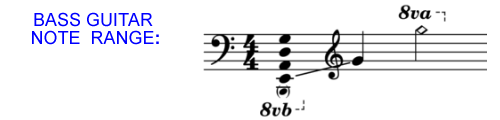
Guitar bass - The Bass Guitar and other Bass string instruments are listed in order with individual details/photos in SECTION B

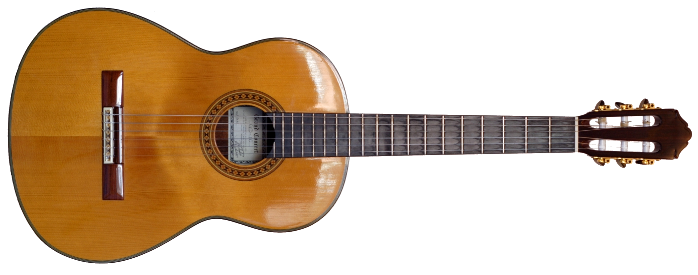
Guitar classical - The Classical Guitar, also known as a Spanish guitar, is a member of the guitar family used in classical music and other styles. As an acoustic wooden string instrument with strings made of gut or nylon, it is a precursor of the modern steel-string Acoustic and Electric guitars, both of which use metal strings. Classical guitars derive from instruments such as the Lute, Vihuela, Gittern (the name being a derivative of the Greek "kithara"), which evolved into the Renaissance guitar and into the 17th and 18th-century Baroque guitar. Today's modern classical guitar was established by the late designs of a 19th-century Spanish luthier, Antonio Torres Jurado.
For a right-handed player, the traditional Classical Guitar has 12 frets that are clear of the body and is properly held up by the left leg, so that the hand that plucks or strums the strings does so near the back of the sound hole. This is called the Classical, or Sul Ponticello, position. However, the right hand may move to the Sul Tasto position, closer to the fretboard, to achieve a different tonal quality. To position the Classical Guitar correctly, the player's left leg is typically raised on a foot rest. The modern steel string guitar, on the other hand, usually has at least 14 frets clear of the body and is commonly held with a strap around the neck and shoulder.

Guitar electric - An Electric Guitar is a guitar that requires external electric sound amplification to be heard at typical performance volumes, unlike a standard Acoustic Guitar. It uses one or more pickups to convert the vibration of its strings into electrical signals, which ultimately are reproduced as sound by loudspeakers. The sound is sometimes shaped or electronically altered to achieve different timbres or tonal qualities via amplifier settings or knobs on the guitar. Often, this is done through the use of effects such as Reverb, Distortion and Overdrive, the latter is considered to be a key element of electric Blues guitar music and Jazz, Rock and Heavy Metal guitar playing. Designs also exist combining attributes of electric and acoustic guitars: the semi-acoustic and acoustic-electric guitars.
There are several types of Electric guitar. Early forms were hollow-body semi-acoustic guitars, while solid body guitars developed later. String configurations include the 6-string guitar (the most common type), which is usually tuned E, A, D, G, B, E, from lowest to highest strings; the 7-string guitar, which typically adds a low B string below the low E; the 8-string guitar, which typically adds a low E or F# string below the low B; and the 12-string guitar, which has six 2-string courses similar to a mandolin.
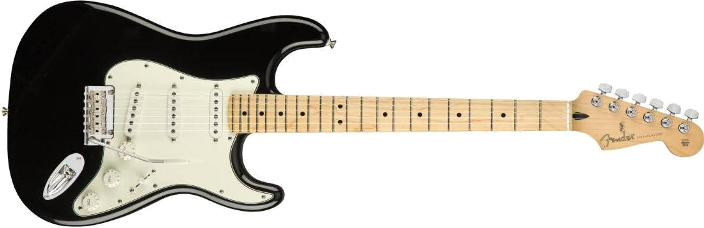
In Rock, the electric guitar is often used in two roles: as a Rhythm guitar, which plays the chord sequences or progressions, and riffs, and sets the beat (as part of a rhythm section); and as a Lead guitar, which provides instrumental melody lines, melodic instrumental fill passages, and solos. In a small group, such as a power trio, one guitarist may switch between both roles; in larger groups there is often a Rhythm guitarist and a Lead guitarist.
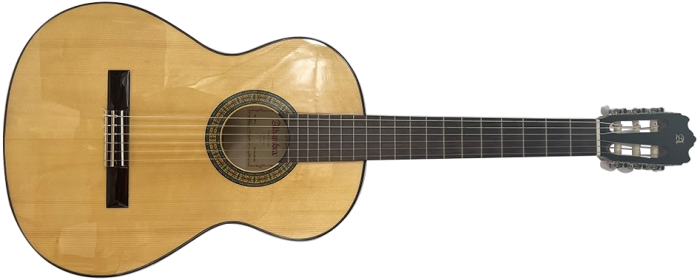
Guitar flamenco - A Flamenco Guitar is a guitar similar to a Classical Guitar, but with lower action, thinner tops, smaller bodies and less internal bracing. It usually has nylon strings, like the classical guitar, but it generally possesses a livelier, grittier sound compared to the Classical Guitar. Flamenco guitars typically have lower action compared to classical guitars. This is for two reasons: lower action facilitates certain fast playing techniques while on the other hand string buzzing is not frowned upon like in Classical performance, and it is often used intentionally as an expressive technique by Flamenco guitarists. In contrast to the Classical Guitar, the Flamenco is often equipped with a tap plate (a golpeador), commonly made of plastic and similar to a pickguard, whose function is to protect the body of the guitar from the rhythmic finger taps
Guitar lap steel - The Lap Steel guitar, also known as a Hawaiian guitar or Lap Slide guitar, is a type of steel guitar without pedals that is typically played with the instrument in a horizontal position across the performer's lap. Unlike the usual manner of playing a traditional Acoustic Guitar, in which the performer's fingertips press the strings against frets, the pitch of a steel guitar is changed by pressing a polished steel bar against strings while plucking them with the opposite hand. The steel guitar's name is derived from this steel bar. Though the instrument does not have frets, it displays markers that resemble them. Lap steels may differ markedly from one another in external appearance, depending on whether they are acoustic or electric, but in either case, they do not have pedals, distinguishing them from Pedal Steel guitars.

Guitar pedal steel - The Pedal Steel Guitar is a console Steel Guitar with pedals and knee levers that change the pitch of certain strings, enabling more varied and complex music to be played than with other Steel Guitar designs. Like all Steel Guitars, it can play unlimited glissandi (sliding notes) and deep vibrati—characteristics it shares with the human voice. Pedal steel is most commonly associated with country music and Hawaiian music. Pedals were added to a Lap Steel guitar in 1940, allowing the performer to play a major scale without moving the bar and also to push the pedals while striking a chord, making passing notes slur or bend up into harmony with existing notes. The latter creates a unique sound that has been popular in Country and Western music, a sound not previously possible on Steel Guitars before pedals were added.

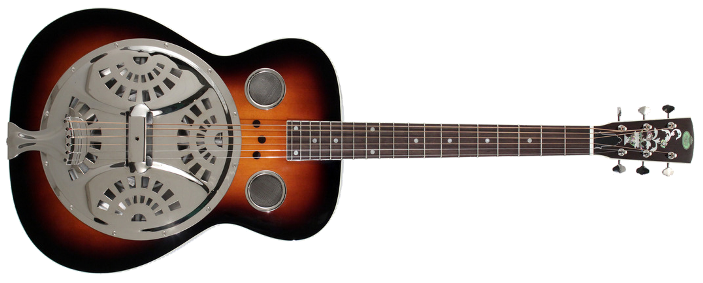
Guitar resonator - A Resonator Guitar or Resophonic guitar (often generically called a "Dobro") is an acoustic guitar that produces sound by conducting string vibrations through the bridge to one or more spun Metal Cones (resonators), instead of to the guitar's sounding board (top). Resonator guitars were originally designed to be louder than regular acoustic guitars, which were overwhelmed by horns and percussion instruments in dance orchestras. They became prized for their distinctive tone, and found life with Bluegrass music and the Blues well after electric amplification solved the problem of inadequate volume.
There are 3 main resonator designs:
- The Tricone, with three metal cones, designed by the first National company.
- The Single-cone "biscuit" design of other National instruments.
- The Single Inverted-cone design (also known as a spider bridge) of Dobro brand instruments and instruments that copy the Dobro design.
Many variations of all these styles and designs have been produced under many brand names. The body of a Resonator Guitar may be made of wood, metal, or occasionally other materials. Typically there are two main sound holes, positioned on either side of the fingerboard extension. In the case of Single-cone models, the sound holes are either both circular or both f-shaped, and symmetrical. The older Tricone design has irregularly shaped sound holes. Cutaway body styles may truncate or omit the lower f-hole.
Guitar picks - A Guitar Pick is a rounded-triangle shaped piece of plastic used to "pick," that is strum or hit, the strings of a guitar and comes in varying Sizes and thickness to accommodate the different playing styles and kinds of strings. See our web Page on GUITAR PICKS in the Guitar Intro section.


Guitar strings - Guitar Strings are lengths of metal or plastic that you strum away at to make sound. There are many different types of strings made of different materials and gauges (thickness) for different purposes. The E and B (1st & 2nd) strings on Acoustic and Electric guitars are plain whereas the remaining strings have windings (wound). See our web Page on GUITAR STRINGS in the Guitar Intro section.
|