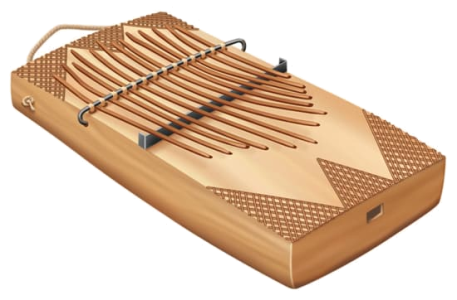
Lamellophone - A lamellophone (also lamellaphone or linguaphone) is a member of the family of musical instruments that makes its sound by a thin vibrating plate called a lamella or tongue, which is fixed at one end and has the other end free. When the musician depresses the free end of a plate with a finger or fingernail, and then allows the finger to slip off, the released plate vibrates. .
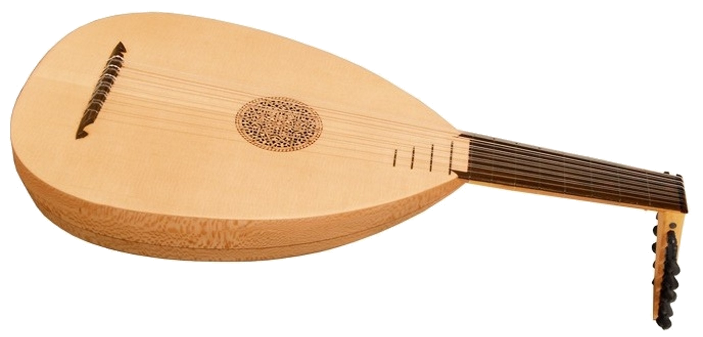
Lute - A Lute is a plucked string instrument with a neck and a deep round back enclosing a hollow cavity, usually with a sound hole or opening in the body. It may be either fretted or unfretted. The strings are attached to pegs or posts at the end of the neck, which have some type of turning mechanism to enable the player to tighten the tension on the string or loosen the tension before playing, which raises or lowers the pitch of a string, so that each string is tuned to a specific pitch or note. The Lute is plucked with one hand while the other hand "frets" (presses down) the strings on the neck's fingerboard. By pressing the strings on different places of the fingerboard, the player can shorten or lengthen the part of the string that is vibrating, thus producing higher or lower pitches (notes).
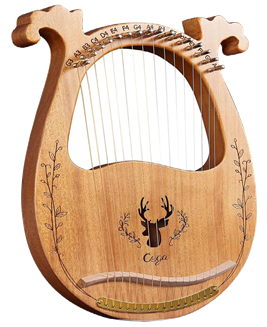
Lyre - The Lyre is a stringed musical instrument that is classified as a member of the lute family of instruments. The Lyre has its origins in ancient history and were used in several ancient cultures surrounding the Mediterranean Sea. The earliest known examples of the lyre have been recovered at archeological sites that date to 2700 BC in Mesopotamia. The number of strings on the classical lyre therefore varied, with 3, 4, 6, 7, 8 and 10 having been popular at various times.
|